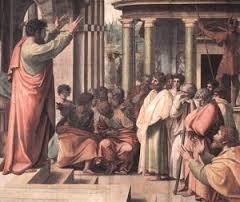
Healing, Loyalty, Forgiveness

I have a confession to make.

There are many times that I look at the Sunday readings, and I am at somewhat of a loss. What is there new to say?

And frankly, this story of Jesus and the paralytic falls into that category for me. More discussion on the age-old discussion–easier to forgive sins or heal?

So I went to the a site that I visit frequently, often just to read the thoughts of others. And I found the most wonderful reflection on this beautiful text (Mk 2: 1-12).

And I was sure that I could never write anything new or fresh given how wonderfully John Pilch had written on this extraordinary passage.

And then I went in search of an appropriate picture, and I found this one, and suddenly it was if some synchronicity had struck. It all came together in this wonderful realization that this was the perfect passage to lead us into Lent.

For we do begin that journey in a few short days. And this passage is really all about that journey.

As Mr. Pilch pointed out, first Jesus responded to the loyalty (which we call faith) in the friends of the stricken man and in their combined persistence to seek healing in the face the scribes who sat about skeptical of this man.

In return for that loyalty to him, Jesus heals–not the physical infirmity, but the soul infirmity. He forgives.

Finally, he cures. The paralysis is removed. And then, he sends the man back to his community.

We are poised to begin our journey with Christ. The road ahead is unclear but it calls us deeply, and strongly. We respond, not with some prescient knowledge of the future, but in faith, or loyalty to this Jesus whom we have known for a long or a short time. We have come to trust him, and know that he will not lead us astray.

Still, we do not KNOW. After all, it is faith we espouse. When we are loyal to friends, we are such not because we are sure of every request made by our friend, but because we trust them to never ask of us anything impossible or wrong.

We know we need healing. We have sinned, both by deliberate action and thought, but unknowingly, and often with the best of intentions. We are human, and it is not possible to avoid error in our thinking or acting, no matter how careful we are. And so we instinctively know that we are in need of Jesus’ fair hand upon our brow, comforting and soothing away our pain and sadness at our failures.

In some sense we are cured as well. Not perhaps of physical disease or illness, but of those distractions of life that pull on us constantly to turn away from ourselves and our spiritual being in pursuit of the mundane. Surely there is much that must be attended, mortgages need paying, food needs preparing, homes need cleaning. But we of course are prone to much more that is unnecessary. Too much television, Internet, frivolous wasting of time in arguing about events and things that will be there tomorrow.

Jesus helps us to see that we need this time desperately, because it is this time that prepares us to take on all the burdens of life for the rest of the year. Not just take them on, but in a way that does our faith proud, that sets us apart as a people who “do it differently” without hurting and cheating and indifference. Especially the indifference.

Jesus calls us to stop and remember that every step we take, every action has consequences to a global community. The things we buy and consume were made by others, in often far off places. Their lives may be very different from ours, and often much more limited and pain filled.

The paralytic is ordered to return to his community. We are to return to ours as well. We have been healed, we have been found faithful, we have been cured. We are called to live that life, within those parameters.

The journey is about to begin.

Amen.

Entering Into Ourselves

This sixth week in Ordinary Time brings us to leprosy, miracles and encounters with sin.

We today have little exposure to the disease known as Hansen’s Disease or leprosy. Indeed, there is some reason to believe that the ancients had less contact than we would be led to believe by the stories.

Given the limited medical knowledge of the Hebrews, leprosy was attached to any physical blemish, any disfigurement. Thus it was a mark upon the body, or upon anything for that matter, that was indelible, not going away.

 In Leviticus, Moses is advised by God how to deal with lepers, how they are to be excluded, kept apart and the leper must identify himself as such to all who come near.

As we know, in those times, physical illness or disease was associated with sin. This whole concept is played out in Job, where his friends are convinced that Job must indeed be sinful in order to be given such suffering.

We can look upon the reading in Leviticus and we can quickly see that analogies can be drawn to our lives today. We of course no longer avoid and look upon as sinful, those who suffer physical disease of any sort. At least we proclaim that we do not. It is of course still a question as to whether we look away and avoid those who have AIDS, or those who are homeless and alcoholic or drug addicted. Perhaps, I spoke too soon.

And we of course also avoid drawing a parallel between disease and sin. We understand disease as an ailment of the body, having nothing to do with the heart or the relative goodness or lack of it, of the victim. Or do we?

Jesus’ answer is unequivocal  as he heals without a single question, the leper who begs his help. There is not examination of his thoughts, beliefs or life before Jesus undertakes the cure. He simply reaches out and effects the cure.

And what of that? By touching the leper, he has committed the act of making himself “unclean” as well. He has become as the leper, and in doing so he demonstrates that there is no sin and no shame in the condition. He separates physical disfigurement from the habits of the soul.

And in doing so, Jesus forces us to look at ourselves, for we must now face the real fact that sin is not always apparent. It is not something visible we can see, it can and is hidden. And that means that we too may be harboring secret sin; sin we have not looked for, let alone confronted and dealt with.

The fallacy that sin is something easy to locate and define, confronts us, and we are humbled.

We are further humbled by Jesus’ willingness to take that public abhorrence upon himself and show it for what it is.

We, as lepers ourselves, unknowingly separate ourselves from God. Yet we too have only to reach out and ask for healing, for that transforming touch that will restore us to health in our souls. As the leper did, so can we do. But first we must accept our dis-ease, and seek renewal.

In a few weeks, we will begin that annual time of seeking to uncover our infirmities and to seek forgiveness and restoration. It is not too soon to begin the journey.

Amen.

Going Forth to Serve

Today’s gospel brings forth a passage that has disturbed many, especially in today when we view women’s struggle for full equality as a given.

Many commentators and not a few biblical experts are dismayed at the opening section of Mark 1:29-39:

On leaving the synagogue
Jesus entered the house of Simon and Andrew with James and John.
Simon’s mother-in-law lay sick with a fever.
They immediately told him about her.
He approached, grasped her hand, and helped her up.
Then the fever left her and she waited on them.

Here we go again, they sigh, Simon’s mother-in-law is made well only so that she can get up from her sickbed and take care of the men!

But such analysis misses a very salient and valuable point. The term “waited on them” is not akin to our definition. It is not like being a waitress at a bar or restaurant. No, this is a word that is used of deacons. It is a phrase that denotes ministry. Thus, we see that the first deacon recorded in the bible involving this new “movement” was a woman!

We are placed on notice immediately, that this ministry (that of Jesus) will be like no other.

Looking to the first reading from Job (Job 7: 1-4, 6-7) we see the deep pain and suffering that living is. Albeit, Job’s suffering is caused rather than merely encountered, the point is the same. We cannot ask of the world any “easy ride”. There is no bargain, no amount of pleading or working that will insulate us from the travails of normal life. We cannot make the night end more quickly, or avoid the aging process.

Life, real life is encountered only through faith in God. Paul claims that this sort of living is so wonderful that he cares not at all what he must endure to live it.

To the weak I became weak, to win over the weak.
I have become all things to all, to save at least some.
All this I do for the sake of the gospel,
so that I too may have a share in it.

Paul tells us that sharing in this new life is worth being weak and being a slave to all. It is worth ridicule and hardship. All is worth it to “have a share in it.” And Paul here, I would argue is not talking about his “ultimate salvation”. He is not saying that I endure all this so that I may be taken to heaven as a good soldier when I die. Rather he means, that by doing what he does, he is living heaven right now! This is the point. This is what is driven by faith, and what drives faith. One supports and enhances and furthers the other.

Mark shows us that this life is about healing. It is about driving out the demons that possess us, and curing our sicknesses, physical or otherwise. This is life–to seek out and help those who are in need, to show them the way to life.

Jesus finds what he needs in his retreat to prayer, where he is nourished anew. Yet, when found, he transitions back to the world:

He told them, “Let us go on to the nearby villages
that I may preach there also.
For this purpose have I come.”

It is our purpose to. Not to necessarily preach, as Paul did, though some are called to that. For most of us, living means to be in synch each moment with who we are, and who we are called to be. As Carlo Carretto suggested, we live on the vertical and horizontal at the same time.

(on leaving the desert) And so I found myself back in the world, in the midst of all the confusions, surrounded by my fellow men and women. …Humanity too is an absolute, and you must seek, love, and serve human beings just as you seek, love, and serve God. Jesus let us in no doubt about this inexorable and simultaneous movement into the two dimensions, the horizontal and the vertical.
The closer you come to God as you ascend the slopes of contemplation, the greater grows your craving to love human beings on the level of action. The perfection of men and women on earth consists in the integration, vital and authentic, of or love for God and our love for human beings. ~Carlo Carretto, In Search of the Beyond

It is living authentically.

Amen.


It Always Comes Down to Authority

 Mark tells us this in this day’s Gospel, that Jesus “spoke with authority and not as the scribes.”

What does this mean?

A cursory look at the definition of “authority” offers little help.

“The power to enforce laws, exact obedience, command, determine, or judge.”

No one would accuse Jesus of “exacting obedience”. Rather, he gave us reason to obey, warning us sometimes of the consequences of not obeying, but never does he force us to do his bidding.

Further, the word “power” seems inappropriate here.

Mark’s audience, as best we are able to discern, was under great pressure. That pressure came from Rome, who was at the time engaged in exacting its “authority” over the Jewish lands, especially in Jerusalem, the seat of the uprising.

Mark’s community, probably from somewhere outside Jerusalem, saw the brutality and ruthlessness of the Roman war machine.

So we must look elsewhere for what Mark meant by using the term “authority” as regards Jesus and his teaching.

I think that comes from his juxtaposition with the phrase “not as the scribes.”

We know that the scribes at the time were the “literalists” of their day. They interpreted the Scriptures and defined what was acceptable and what was not to the greater population. There were various codes to be adhered to, various practices that must be accomplished to be and remain in good standing as a Jew.

So they had a certain authority it would seem, since they declared the clean from the unclean, the pious from the not, yet, apparently they did not impress the population as speaking for God. Rather, they spoke as the established “church”. Few if any, so it seemed, thought of their teaching as anything but rote repetition of rules and regulations.

No, Jesus spoke as a prophet, one sent by God to EXPLAIN. A prophet is not a seer of the future, but one who assembles the “threads of the day” and explains what they mean for the average person. Prophets are sent when people “don’t see the obvious” and need to be told what is coming (if they don’t change their ways).

Mark goes further.

As I said, Mark’s community is under great threat. Mark, doesn’t stop with just explaining that Jesus has this “authority” and should therefore be listened to as a prophet. He fairly hits his community up the side of their heads!

Jesus cures a man cursed with a demon, and the demon shrieks, “I know who you are. The Holy One of God!”

No question now. Jesus is not just a prophet, he is God’s Holy One! “Listen to him,” Mark proclaims.

One can but imagine the uproar this caused in the synagogue that day. First this rather nobody from a small outlying village arrives and without schooling or training, speaks in the synagogue, explaining the scriptures in a way apparently new and quite different from the usual recitation of admonitions and blandishments. And then, he disrupts the sacred place with a healing, calling forth demons who shriek and create a ruckus.

“What is this?”

What indeed?

We can see in our mind’s eye, the crowds slowly walking away in small groups, whispering among themselves. We can imagine that the synagogue authorities watched all this and gathered too, to discuss this event, and what it might mean.

We all are required to obey certain authoritative acts. We must pay taxes, obey traffic laws, obey our parents, our bosses. That is normal, and for the most part good, for society depends on a degree of compliance voluntarily given.

However, we must always remember that there is a “higher authority”, one that always supersedes earthly rules. It is the authority written in our hearts by a loving God who has impressed upon us an ingrained “knowledge” of moral right. Jesus speaks as this “authority”. We read his words and ponder his teachings, recognizing that our hearts respond to the “authority” of his teaching.

While we often wish to rebel and take a “have you come to destroy us?” attitude, we know the truth of what He speaks.

Let us always shed evil and stand in the light of God’s truth.

Amen.

When God Speaks, People Listen!

Jonah has to be one of the oddest people in the bible. Certainly the oddest prophet.

If ever there was a person unsuited to be God’s messenger, that person would be Jonah.

When God first announces his mission, why Jonah tries to run away. This in itself is ludicrous, for who can escape God?

Of course, God’s way of dealing with Jonah’s refusal is most unusual, causing untold havoc to poor sailors whose ship he used as a means of travel.

Every child knows the story of how Jonah was thrown overboard and swallowed by a “whale” and spit forth upon the shore near Nineveh.

Thereafter, Jonah goes into the city and proclaims it’s destruction because of its sinfulness.

And, as everyone would hope (save Jonah) the people repent and God hears their repentance and is satisfied and spares the city.

This of course ticks off Jonah to no end, who sees God as some softie, all too willing to accept “repentance” and reject his plans to destroy the city.

Jonah quite plainly doesn’t like the way God operates.

I can imagine that God finds Jonah amusing, chuckling at Jonah’s theatrics, “Just kill me now!” he cries.

In thinking about it, I realized, that given Jonah’s lackluster committment to God’s desires, one can but imagine how he “announced” to Nineveh’s inhabitants, their imminent doom.

Imagine if you will, Jonah, walking slowly down the street, “only forty days more and Nineveh will be overthrown,” he murmurs to various passersby.  I imagine he says this in a rather sarcastic, matter-of-fact tone, with a tired voice, uncaring, and unsympathetic. All he can think of is that he has miles to go before he is done. And of course he wants to be well out of the city before the show begins. He needs time to scope out a good hill to watch the fire and brimstone show.

And yet, people respond immediately to his words. They ACT, from the lowliest to the King, all  take on sackcloth and ashes as is appropriate to show great mourning and repentance.

All of which ticks off Jonah all the more, since his wimpy God now forgives them, and spoils his show. All that popcorn, and nothing to watch!

It may seem a bit odd that Jonah’s story is placed in counterpoint to that of Jesus travelling along the Sea of Galilee, and calling to Simon and Andrew and the sons of Zebedee.

Jonah is the antithesis of Jesus in every way.

Jesus will prove to be the herald of God’s loving forgiveness and the king of forgiveness himself.

Yet, they are alike in one way:

The power of God speaking through them is heard and responded to immediately by those who hear.

Who has not gasped when reading this story, literally every time one reads it. Four men, all working men, all in a sense businessmen running their own enterprises, drop everything and follow this man who calls them forth.

They do not stop to discuss the wisdom of leaving their tools (their operating machinery), nor do they wonder how they will feed themselves and their families. They do not seek advice, ask any questions, or look upward for divine guidance.

They “abandon” their belongings, their families, all those who depend upon them, all because something in that voice commands them to in a way that leaves no doubt as to its origins.

Please give me that chance God, to drop everything and follow you without question, we cry.

Amen.


A Quest for God (Series)

I sometimes miss how incredibly good Biologos is. The site continues to impress me with its insightful and well thought out posts on science and faith. I must have missed the others, but happened upon the fourth in this series. It is described thusly:

Recently, we became aware of an email conversation between two young persons: one a young physicist and a deeply committed Christian named Aron and the other, Josh, a person who at least at the time the conversation began was a skeptic. The exchange is so rich that we’ve asked for permission to post it here.

Following are the links to the four parts. I place them here, so I can read them when I have the time, and hopefully you will too.

Part I:

Part II:

Part III:

Part IV:

Who is This Baptist?

I have always found John the Baptist a bit troubling.

That is, in spite of the fact that I find him most appealing.

He has that rogue contrarian eccentricity about him that I find compelling.

Everyone knows somebody in their family who is like that. Someone who is a non-conformist. Who speaks their mind, who is unconventional.

John surely fits that bill.

His parents were alerted both before and after his birth that he was special, and that he had a special place in the future of the Jewish people. Read Luke’s early chapters if you have any doubt.

He was “different” from day one.

And, in most of the scriptures, he was quick to recognize Jesus as the one for whom he had come. There is little doubt of that either.

In today’s Gospel, he merely says, “Behold, the lamb of God,” and Andrew, son of Peter, follows without question. John’s voice is powerful, his announcement carries weight. It is no different from in other parts of Luke and Matthew. John knows Jesus for who he is, and proclaims him without question or hesitation.

That is until later in Luke when John sends two of his disciples to Jesus to inquire: “Are you the one who is to come, or are we to expect someone else?” (Lk 7:19).

What? Is John now confused?

Or is John simply mirroring us?

We all, somewhere along the line of our faith journey, create a vision of who this Jesus is. We define him and his mission. We are assisted or hindered in that creation by a plethora of others, mostly well-meaning if often horribly wrong. They tell us who Jesus was and is for us today. To hear some, he was against socialism and unions, and for self-reliance. It gets a bit confusing.

But, in the end, we are left with this mosaic of Jesus, compiled, erroneously or not, in part or in full, of all of our learnings and experiences.

Is it any wonder that we wonder sometimes? “Are you the one who is to come, or are we to expect someone else?”

John, it seems to me, was reflective of this.

He had notions of who Jesus was supposed to be, and however that was, certain reports must have come to him about the Lord that were not what he expected. And so he began to doubt.

This man whom I touted as THE one, the one I sent others to, perhaps, just perhaps, I was wrong. Perhaps this Jesus is not the one my parents told me I was to herald.

So too do we wonder. Not so much about whether “this is the one” as whether we have a clue who this One is.

From time to time, he acts not at all like we would wish or expect. We are called upon to rethink the whole thing.

And as we do so, it seems to me, that most of the time we are called upon to let go of our self-serving definitions and explanations. We find that this savior is not an easy man to know or to follow. He demands of us a good deal more than we expect, and in ways wholly different from we thought.

And yet, or so it seems to me, we find this savior more worthy of following as we chip away our self-imposed lacquer. We find Him radically different from we had supposed, and we are again and again stunned with the brilliance of his light. If anything we find Him more compelling, rather than less as we discard the childish simple veneer we have so simplistically applied to Him.

One wonders what John thought as he discovered, if he did, that his vision of Jesus was quite different from the reality of the Lord.

Amen.

From Whence the Answer Comes

Today we celebrate the Epiphany, or what some call the Feast of the Three Kings. We turn to the Gospel of Matthew, 2:1-12.

Previously, Matthew explained the lineage of Jesus, and followed that with a brief statement of the circumstances of his birth.

Now Matthew provides the revelation.

Epiphany is a Greek word ἐπιφάνεια, epiphaneia, meaning the sudden comprehension of the full meaning of something.

And indeed, Matthew does this in an extraordinary and rather shocking way.

Herod is introduced though of course he needed no introduction to Matthew’s audience. Herod was King, yet he was propped up in his Kingship by Rome, for the religious leaders of Jerusalem never had favored him.

Soothsayers or astrologers from the East come looking for the child born under a new star, foretold to them in ages past, as harbinger of great birth. Herod hears of this and calls them to explain. What he hears “greatly” troubles him, as well it might to any king who knows his power remains on such shaky ground.

Ultimately of course the Magi find Jesus and pay him homage, and then by way of dream, they return not to Herod as promised, by avoid him as they return home.

By strangers, non-Jews, we are advised that this child IS the one, the savior. God has chosen, not Herod, not the religious leaders of the land, but strangers from the East to proclaim  that the Kingdom of God has entered into the world.

What a shock this must have been to Matthew’s listeners. How could God speak more clearly than to do something so utterly unexpected.

This should give us pause.

For we are trained to look to experts and our leaders to tell us what we need to know. We are expecting our “betters” to explain the importance of events in our lives. As children, we look to our parents and other adults. As students we look to our teachers. As workers to our supervisors. As citizens to our elected officials.

Yet God chooses not to introduce His son upon the human stage through the Jewish leadership, nor through Kings, no matter how titular. He choses foreigners, those who don’t share the faith of “his people”, if indeed we should limit God in such a way.

And we can be sure that they arrive by no simple error in reading the “tea leaves” if you will. No. We are sure God spoke actively to them for he warned them away from disclosing Jesus’ whereabouts as they had promised.

We, in our sophisticated lives have moved far away from seeking answers directly from God. We look in the Wall Street Journal for financial advice, or to PBS for political analysis of which candidate is best. We walk on by all those around, the simple people like ourselves, because we have forgotten that God moves in mysterious ways.

There are too many jokes and short little examples of how humans, in our determination to find God acting as we expect him to act, often miss his finger pointing out our direction.

What could three strangely dressed, strangely speaking men from a far-off land, have to tell me about anything we ask. Yes indeed, what could they have to tell me?

Are we listening?  Are we keeping our eyes open?

Out of the mouths of babes, as the saying goes.


. . .and Pondered Them in Her Heart

We conflate the birth stories of Matthew and Luke, even though it is not proper. So hungry are we to understand this Jesus that we gather every scrap of information, and from it create a mosaic of events.

So, most all of us recall the story as a time when the shepherds left their flocks in the fields and traveled to Bethlehem to view the newborn child and when “wise men” came as well for the same reason.

Of course, the shepherds only occur in Luke and the wise men in Matthew.

Imagine Mary’s shock at these events. Would it not be shocking for shepherds to abandon their flocks at the most vulnerable of times, the dark night? And who were these wise men? Eastern astrologers, or soothsayers bringing expensive gifts to lay at the feet of an infant born in humble surroundings and wearing common course swaddling?

At yet, this is what is presented to us. Shepherds and Magi are all alerted that something extraordinary has taken place in this out-of-the-way location, and they are compelled to witness it. And yet what they witness is by all accounts, not extraordinary as we have said. A child lies in a bed of straw, dressed as a common child might, being born to a carpenter and his wife.  Nothing is said or done to mark this occasion, yet the shepherds return to their fields giving praise “for all they have seen and heard.”

And Mary? Why,

“. . .she treasures all these things and pondered them in her heart.”

As well she might, for what she saw was much the more extraordinary than the birth of her child would have appeared to be. Imagine he wondering what exactly was it that had brought them here to her and her newborn?

Yet when you think of it, her treasuring and pondering are not really extraordinary either. They are the things that every mother and father do when presented with the fait accompli: the birth of a new human being that they are responsible for. What had been a future possibility, had now become a most serious reality.

What parents do not sit and wonder at what all this really means. How their lives will change. How they will respond to the challenges ahead. But more than this. There is pondering aplenty  about just what is in store for this new life. What kind of life? What career? What loves? What heartache? What disappointments? What triumphs.

Indeed there is much to ponder.

And we sit today, on this first day of the year, pondering aplenty as well. This new year, this remembrance of new birth and the promise we live in.

It is right and good that we ponder today. We must ponder about who we have become, who we will become, what we wish to become. We must ponder if we do enough, too much, the right kinds of things, the wrong? We must ponder what others do and why, and assess its impact and value on the common good. Do we contribute to the Kingdom? Are we a stumbling block? Are we indifferent?

A thousand ethical dilemmas come our way. We are constantly weighing and balancing plusses and minuses and doing it all while holding to certain standards of evaluation. We are not always right, nor are we always wrong. We try to be more right than wrong. But we know that it is in the pondering that we come closest to our Master, for he would have us ponder aplenty.

Jesus calls us to not accept the pat answer, the easy standard, don’t think about it reply. He taught us that things are seldom what they appear to be on the surface, and the easy answer is seldom the best. He calls us to work at working out our salvation.

Mary, sister of Martha was a ponderer. And Jesus you recall, said she had the better part. Wisdom arises not from living, so much as thinking about what we have lived through, what we did wrong, what we did right, what we might have done differently, and applying it to the future.

Ponder today, as you welcome in the new year. For it will be filled with surprises, disappointments, triumphs, laughter and sadness. And in the end, what will matter most is how you responded to it. Ponder well.

Amen.


He Comes!

The story of the birth of Jesus is one that was set down many decades after his death. As such, it has always troubled biblical experts. The mere fact that the year of his birth is unknown today, suggests that the story was largely one invented by the early church.

But, unwittingly or not, they did get the main idea quite right.

No, Jesus was almost certainly not born on December 25. The date was almost assuredly borrowed from the cultic religion Mithras, who was also claimed to have been born on that day, and was popular in Rome in the early years of Christianity.

Jesus was also probably not born in Bethlehem, but rather in his home town of Nazareth.

But he was born to a poor family, living a simple life. His father, Joseph was claimed to be a worker of wood, although some suggest the trade was actually stone mason, and it is entirely likely that Jesus, in his earliest years worked in the nearby town of Sepphoris, which was undergoing a major building boom.

His birth likely elicited not great announcement, other than to friends and relatives nearby. This likely accounts for our extremely limited knowledge of his early years.

But what was perfectly true, was that Jesus was not born to riches nor born to royalty. He was of the most humble of backgrounds. As he abandoned his trade, and went on the road as an itinerant preacher, he was not financed by the wealthy and powerful of Jerusalem or of the Jewish leadership. He was an unknown, from a fairly backwater town, of unremarkable family.

This made his teaching all the more outlandish to those in power. Who in the world did he think he was after all?

He healed the sick and those who were rejected by society for any number of reasons. He embraced the lame, the blind, the reprobate, the tax collector, and all those who were publicly pointed at and scorned.

Indeed, Matthew reports in his famous story in chapter 25, that even those who Jesus declared to be “good disciples” had no more idea of why they had found favor than those who did not. Jesus announced quite simply: “when you did it to the least of these, you did if to me.”

This is the lesson of Christmas.

Jesus came not to argue fine points of law with the rabbis and temple priests. He came not to add burdens to those already crushed by burdens. He came not to further exile the marginalized and reject them from God’s love. He came not to rule in any traditional sense that we understand today.

He came to declare that God embraced them and loved them, and that they were the ones for whom the Kingdom was designed.

He spent his life, all of it, among those who were the least in the world in which he lived. They were the least of the Jewish world, and they surely were even less in the world of Rome. He ministered to them, he taught them, he healed them, body and mind.

So, in fact, the story of Bethlehem, so beautifully told by Matthew rings with a beauty that is breathtaking to us still today. In a manger, in a back room, among the animals, a baby is born to a simple man and woman, who will in his time change the entire world forever more.

A man, not born to riches, nor born to sit with kings, will be king in the most real way imaginable. He will remind us that it is not what we do, but what we are. And we are a being that by its very nature is meant, by genetics or by God’s design, to be in community.

We are called to love one another, to serve one another, to protect one another. It is not ever enough to stand up for what we believe, out of principle. That is expected of us. As Jesus would put it, even the Pharisees would do as much. But we are called to stand for all those who cannot stand for themselves. That is our mission. That is what makes us Christians.

Today, spend some time, perhaps as the evening closes down, thinking about who needs your help. Will you be a voice for the gay community? For the homeless? For Muslims? For immigrants? For the elderly? For children? For oppressed people in other lands?  Dedicate your next year to embracing some “other” in our world and doing what you can to stand in solidarity with them. Work for their interests.

I promise you, you will be working for your own. And God’s.

And what else need you worry about?

Previous Older Entries

Blog Stats

  • 34,756 hits
Follow

Get every new post delivered to your Inbox.

Join 128 other followers